From the Middle Byzantine period onward, Holy Athos provided the most appropriate model for the organization of monastic life in monastic centres established at a later date. The Athonite monks who moved from Mount Athos to the monastic communities of Ganos and Papikion were undoubtedly the bearers of this particular, organized form of monasticism there. One example is St Athanasios, to whom we referred earlier.
Returning to the Life of St Maximos, we should note his recorded relationship with the great teacher of hesychasm and exponent of the hesychast method of prayer on Mount Athos, St Gregory of Sinai. Indeed, a relevant excerpt from the Life of St Maximos, written by Theophanes, Bishop of Peritheorion, recounts the meeting of the two saints and gives St Maximos’s answer to St Gregory’s question about noetic prayer. This excerpt was also included in the Philokalia, the collection of neptic writings.
The monastic community of Paroria
During this same period, when Byzantine hesychasm was flourishing, a group of hagiographical texts provides us with a considerable wealth of information. It constitutes our sole source for the foundation and historical development of another very important monastic centre: Paroria, on the frontier between Byzantine Thrace and Bulgaria, now within the Bulgarian state. These texts are the Life of St Gregory of Sinai and the Lives of two of his Bulgarian disciples at Paroria, St Theodosius of Tarnovo and St Romylos, who had also practised the ascetic life as a monk on Mount Athos.
The original Life of St Gregory was written by a fellow hesychast, the future Patriarch Kallistos I. He had followed St Gregory to Paroria from the renowned hesychast Skete of Magoula on Mount Athos, a centre for the dissemination of Byzantine hesychasm on Athos, where they had lived as monks. This Life gained a wide circulation and was translated many times in the Slavic monastic world.
Turkish raids from the sea had forced St Gregory and his company, like many other Athonite monks—including St Gregory Palamas and St Athanasios of Meteora—to leave Mount Athos. After many adventures, they travelled by way of Sozopolis and, around the year 1331, reached “the deepest part of the desert” of Paroria. Following a stay of a few years, St Gregory returned to Mount Athos, but then departed once again for Paroria, accompanied by one of his disciples.
St Gregory of Sinai’s second journey to Paroria drew a multitude of monks to him. This led to the construction of the first great lavra on Mount Katakekryomenon; subsequently, three more lavras were built at the cave of Mesomilion and at Paizouva. The Bulgarian Tsar John Alexander supported his work, contributing to the construction of many buildings and to the enrichment of St Gregory’s monasteries with estates, livestock, and considerable property.
The monastic centre of Paroria became a bastion of hesychasm and had a decisive influence on the spread of hesychast teaching throughout the Slavic monastic world. This is apparent both in the Lives of St Gregory’s Bulgarian disciples, Theodosius of Tarnovo and Romylos the Hesychast, and in the work of Patriarch Euthymios of Tarnovo, who had also practised the ascetic life on Mount Athos.
We shall conclude these references in Byzantine hagiographical texts to the monastic centres of Ganos, Papikion, and Paroria with the Life of St Gregory Palamas, written by his disciple St Philotheos Kokkinos, Patriarch of Constantinople. St Gregory had left Constantinople in 1316, or a little later, abandoning brilliant studies and the prospect of a successful career in the imperial administration. His intention was to travel with his two brothers, Makarios and Theodosios, to Holy Athos and become a monk.
When, however, he reached Mount Papikion, for which St Philotheos employs particularly laudatory language—“this holy mountain of old, situated between Thrace and Macedonia and set apart for monks, who at that time were admirable and earnest men, rightly pursuing divine philosophy”—they chose to remain there for the winter.
St Philotheos describes this choice by St Gregory as a work of divine Providence. St Gregory’s admirable ascetic way of life on Mount Papikion astonished the monks of the mountain and won their admiration; it also led to the remarkable conversion of the heretical Paulicians. The Life calls them Marcionites or Messalians. They lived near Papikion and were converted after St Gregory held extended discussions with the leaders of their heresy.
The Life also refers anonymously to the monastic community of Paroria in the passage concerning the hesychast monk and theologian David Disypatos. Paroria is placed there between Thrace and the land of the Scythians and is presented as the place where the admirable Gregory had practised the ascetic life. After his departure, a school of divine philosophy had been established there; David Disypatos sought refuge in it and remained for two years.
Hesychast practice on Mount Athos
The Lives of the hesychast saints, and above all the extensive Life of St Gregory Palamas, also provide very important evidence about monastic life at the most important monastic centre of this period, Holy Athos. Among this material are exceptionally interesting descriptions of its human geography and some of the finest encomia addressed to it.
Thus, Great Athos is described as “the rich and full mountain—as one might rightly call it here too—the mountain of God, on which ‘he who fills all things’ was pleased to dwell, clearly on account of the virtue of those who inhabit it.” It is also called “the monks’ chosen land, the workshop of every kind of virtue, the dwelling place most fitting above all others, for both soul and body, for men of earnest purpose.” These are only two of the laudatory passages found in Lives written by Patriarch Philotheos Kokkinos, a systematic encomiast of Athonite ascetic practice. Philotheos received the monastic habit here in Thessaloniki, at the Monastery of Chortaites, and served as abbot of the Great Lavra before his election as Metropolitan of Herakleia and, subsequently, his elevation to the patriarchal throne.
We are also given very interesting information about the forms of ascetic practice that one might encounter on Mount Athos at that time. An excerpt from the Life of Patriarch Athanasios, whom we mentioned earlier, speaks both of hermit ascetics and of monks living in organized coenobitic monasteries. His biographer, Theoktistos the Stoudite, adds that Athanasios himself, as an ascetic on Mount Athos, went barefoot from the beginning, never acquired a second tunic, and secretly wore a hair shirt next to his skin.
Equally interesting is the information we obtain from the Byzantine Synaxarion of St Philotheos Kokkinos about the Athonite period of his life. Philotheos took refuge on Mount Athos, at the holy school of Athos, and, after a long period of monastic obedience to spiritual and God-bearing men, became abbot of the Great Lavra. He subsequently turned, however, to the eremitic life.
The Life of St Makarios Makres also speaks of anchorites who lived in groups of two or three and persevered in prayer and ascetic labour. They are contrasted with the hermits who, separated from everyone else, conversed with God alone. Some, indeed, were distinguished by their spiritual gifts. The same Life therefore places them at different points on Mount Athos according to the degree of their spiritual perfection, thus transforming the mountain into a spiritual ladder.
Some leave the foothills and ascend the mountain of perfect love. Others traverse the slopes, but do not stop there and hasten towards the summit. Finally, there are those who have reached the peaks and entered the cloud: they were deemed worthy of divine mysteries, heard the voice from above, and saw the back parts of God, by which the contemplation of beings is signified.
We also draw a substantial wealth of information about the monasticism of Mount Athos from the Life of St Gregory Palamas. His biographer, St Philotheos Kokkinos, recounts the details of his hesychast life: from the moment when he and his two brothers arrived at “most beautiful Athos,” as he calls it—specifically, at the Monastery of Vatopedi and with his first elder, St Nikodemos, who had come from the monastic centre of Mount Auxentios on the Propontis—to his move to the Great Lavra and the ascetic huts in its territory, such as the Skete of Glossia and the Cell of St Savvas, as well as his brief appointment as abbot of the Monastery of Esphigmenou.
At this point, we should draw attention to an exceptionally interesting text by St Gregory Palamas himself, which was in fact his earliest work: the Discourse on the Wondrous and Angelic Life of Our Venerable and God-Bearing Father Peter the Athonite. This work was devoted to the father of eremitic monasticism on Athos before the establishment of coenobitic monasteries. It was composed after Palamas’s second journey to Mount Athos in 1330–1331 and served as the starting point of his extensive literary activity. The choice of this subject is undoubtedly connected with the fact that St Gregory remained throughout his life a supporter of eremitic monasticism, albeit under the supervision of a monastery.
It is very likely that this discourse was delivered at the Skete of Magoula, where, at precisely the same period, Gregory of Sinai—the great father and bearer of the Sinaite hesychast tradition—was living with his disciples. Various opinions have been expressed about his relationship with Palamas. The strongest, I believe, is the view that St Gregory Palamas, like St Athanasios of Meteora, was a disciple of St Gregory of Sinai.
This view is supported by the picture drawn by St Gregory of Sinai’s biographer and disciple, Patriarch Kallistos I, of the emergence of the Skete of Magoula as a centre for the dissemination of hesychast teaching throughout Mount Athos during St Gregory’s residence there. It is also supported by the periods when St Gregory of Sinai and Palamas were simultaneously on Mount Athos and by their respective departures from it, as well as by the close relationship that developed between Palamas and disciples of Gregory of Sinai, such as Isaiah and Patriarch Kallistos I. Both were among those who co-signed the Hagioritic Tome of 1340.
Another important feature recorded in Palamas’s encomiastic discourse is the connection between the hesychast life of St Peter the Athonite and hesychast practice as it is developed in the relevant works of this period. As was argued in the past by the foremost scholar and editor of the works of St Gregory Palamas, the late Professor Panagiotis Christou, “specifically hesychast elements are not yet to be found in this discourse.” Nevertheless, it contains several fundamental components of his spiritual teaching.
The close correspondence between one part of Palamas’s discourse and detailed expositions of hesychast teaching in his later works has been identified. Those works include the Epistolary Discourse to the Philosophers John and Theodore, his epistolary treatise to the nun Xenia, On Passions and Virtues, and the Antirrhetics against Akindynos.
This encomiastic discourse by Palamas belongs within the context of the flourishing of eremitic monasticism on Mount Athos during the Palaiologan period. That flourishing is also attested by monastic hagiography’s broad turn towards anchorite saints who spent all or part of their monastic lives on Mount Athos.
We may mention the three Lives of St Maximos Kausokalyvites, a contemporary of St Gregory of Sinai, written by Niphon the Athonite, Theophanes of Peritheorion, and Ioannikios Kochylas; the extensive Life of St Gregory of Sinai, which we have already mentioned, written by Patriarch Kallistos shortly before Palamas’s death; the Life of St Gregory’s disciple Romylos; the Life of St Niphon the Athonite; and the Lives of St Germanos Maroules and St Savvas the Younger, written by Patriarch Philotheos Kokkinos. To this same group belong the relevant works of Theoktistos the Stoudite and Joseph Kalothetos concerning the hesychast Patriarch Athanasios I. All these works concern anchorite saints.
The hesychast tradition in Thessaloniki and, in particular, at the Holy Monastery of Vlatadon
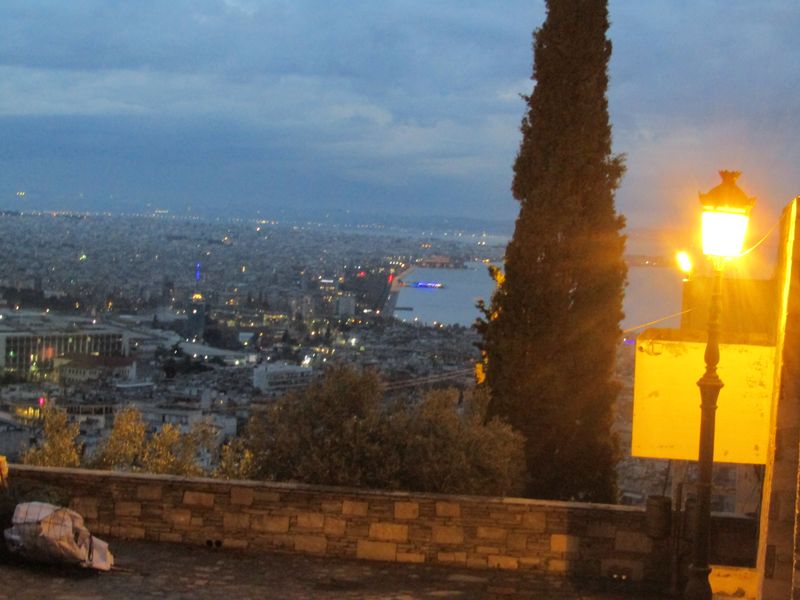
At this point, we shall turn to the connection between Mount Athos and our city, for the relationship between Thessaloniki and Mount Athos has always been distinguished by their mutual spiritual and historical interaction. Indeed, from the first testimony concerning the prehistory and early history of Mount Athos, in the ninth and tenth centuries, Thessaloniki appears as the city that supplied this new monastic centre with people. Among them were the Thessalonian brothers Symeon and Theodore, contemporaries of Saints Cyril and Methodius. They are recorded in the sources as the first known settlers of Mount Athos in the ninth century, “the first inhabitants of Athos and protectors of all Hellas,” framers of the rules of that holy commonwealth, and superiors of the whole Mountain, as their Life records.
Moreover, Thessaloniki appears as both the spiritual and productive hinterland of the Mountain from as early as the time of St Euthymios the Younger. After a long period of enclosure on Athos, he moved to the Thessaloniki region after 865 and revived the ancient ascetic tradition of stylitism in the city’s environs. The same relationship is evident in the case of the father of Athonite coenobitic monasticism, St Athanasios the Athonite. A century later, after 964, Emperor Nikephoros Phokas granted him, for the needs of his newly founded Lavra, the administration of a monastery in Thessaloniki, perhaps the Monastery of St Andrew at Peristera.
This relationship continued to develop throughout the subsequent period; we could cite various examples here. It reached its height, however, during the Palaiologan period, when these two places emerged as the historical and spiritual cradles of Byzantine hesychasm. Both the historical writings of the period—the History of the pro-hesychast John VI Kantakouzenos and that of the anti-hesychast Nikephoros Gregoras—and the rich hagiographical production, especially that of the Thessalonian Patriarch Philotheos Kokkinos concerning the hesychast saints, reveal their physical and spiritual setting, as well as the spiritual elements that distinguish this unique relationship.
So as not to abuse your kind attention or tire you further, we shall confine ourselves to the katholikon of our Holy Patriarchal Monastery of Vlatadon, which bears the strong imprint of the hesychast movement. Moreover, as you know, Palamas’s monastic company appears to have settled on the site of the Monastery.
The creation of the church’s iconographic programme belongs to a time when the Church of Thessaloniki was being rebuilt after the Zealot movement and when Palaiologan Byzantium was experiencing a climate of religious and political revival, albeit a temporary one. According to the prevailing view, our Monastery was founded between 1351 and 1371 on the initiative of Dorotheos Vlates, a man of venerable life, and his brother Markos.
The former also served as Metropolitan of Thessaloniki from 1371 to 1379. Together with his brother Markos, he had undoubtedly been among the most faithful disciples of St Gregory Palamas. They even followed him to Constantinople, where he had been summoned in 1340 to defend himself before the emperors and the Synod, and they remained confined with him at the Monastery of Christ the Saviour Akataleptos.
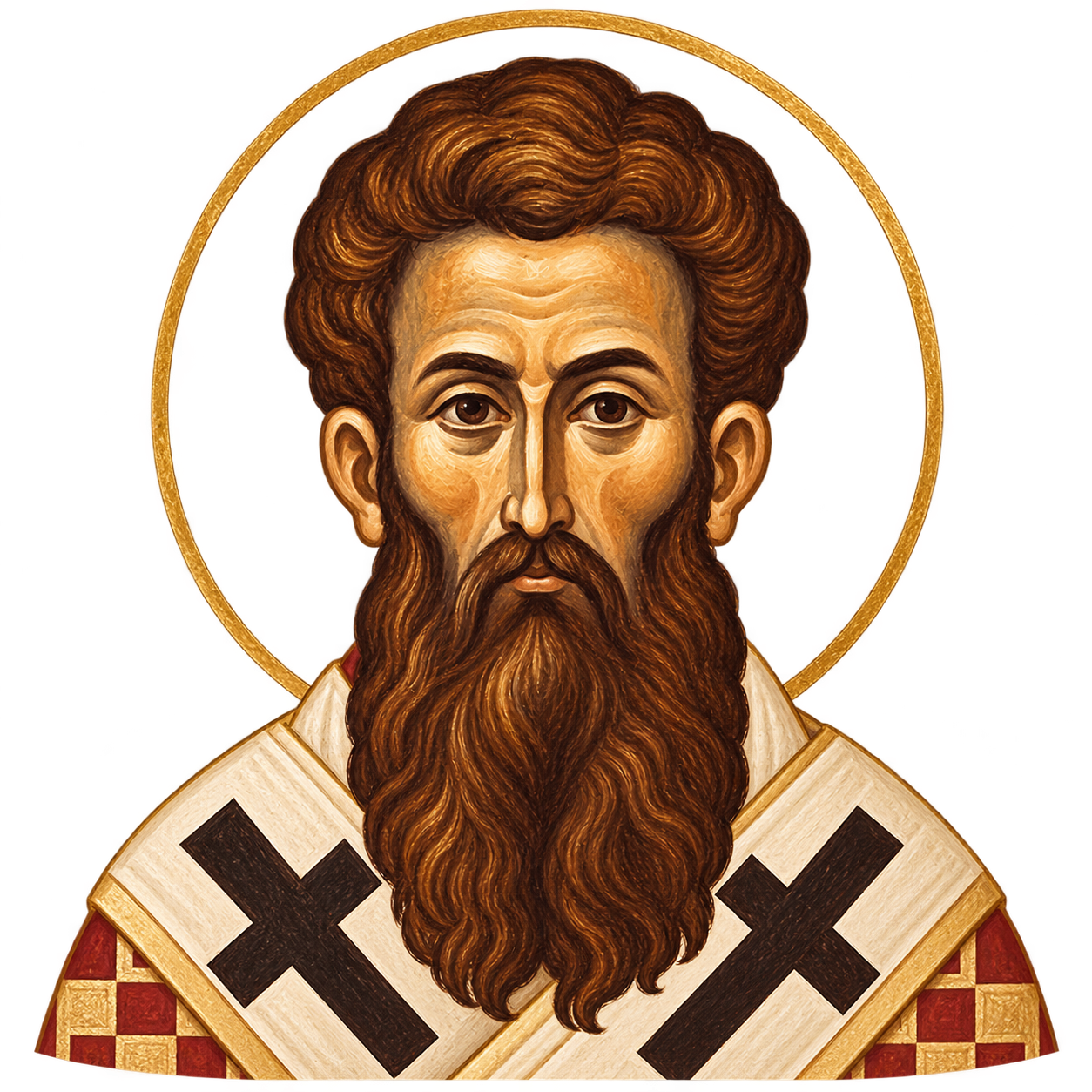
The depiction of St Gregory Palamas constitutes an important piece of historical evidence and an indicator for dating the unique Palaiologan frescoes in the katholikon of our Monastery, since he himself, as you know, had also served as Archbishop of Thessaloniki from 1347 to 1359. This depiction, together with the existence of the former chapel of St Gregory Palamas on the site where the Chapel of the Dormition of the Theotokos was later erected, emphatically indicates his connection with our Monastery. The presence of a halo suggests that his official proclamation as a saint, which took place in 1368, had probably already occurred.
According to Mr Georgios Fousteris, a colleague of our Monastery, Patriarch Philotheos has been credited with shaping the iconographic programme of the chapel and church before 1364, while he occupied the patriarchal throne.
The katholikon of the Monastery of Vlatadon, built through the patronage of the brothers and hieromonks Dorotheos and Markos Vlates, became the most important centre of the hesychasts in Thessaloniki after St Gregory Palamas was enthroned as its archbishop. In 1350, in the context of the hesychast movement’s triumphant ascendancy, several of his disciples arrived in Thessaloniki together with Palamas, who received a splendid welcome.
Dorotheos Vlates was one of them and was unquestionably an outstanding spiritual figure of his age, having developed an important pastoral ministry under the protection of his teacher and in the presence of Anna Palaiologina. In the Monastery’s surviving frescoes, a central role is played by the intention of Dorotheos, its founder and abbot, to highlight the person of St Gregory Palamas.
Palamas is depicted twice in key positions, both in the main church and in the southern Chapel of the Apostle Paul. His earliest surviving depiction is in the main church. Because of its position in the doorway, it functions as a guardian of the church’s entrance. Palamas’s figure has been rendered with portrait features and differs from the later idealized depictions.
It is also interesting to note that veneration of him began immediately after his death in 1359, both on Mount Athos, where he had been a monk—the best-known example being his contemporary depiction in the Chapel of the Holy Unmercenaries at the Monastery of Vatopedi—and in Thessaloniki, Veria, Kastoria, and elsewhere. The construction of churches and creation of icons in his honour in these regions are characteristic expressions of this veneration.
We also know that Palamas’s official recognition as a saint was decided by the Patriarchal Synod of 1368 and that Philotheos Kokkinos, Patriarch of Constantinople, played the leading role in this process. He also composed the encomiastic discourse, the Life, the Service, and the Miracles of St Gregory Palamas.
At this point, it is worth commenting on the scene of the Transfiguration on the western vault of our Monastery’s katholikon, which is inseparably connected with the background of hesychast theology concerning the Taboric light. Particularly characteristic are the shape of Christ’s rhomboid mandorla, which is enclosed within a circle, the emphasis placed on the central rock of Mount Tabor, and the Apostles’ vigorous movements.
The fact that, according to St Gregory of Sinai and St Gregory Palamas, the Transfiguration constituted a direct theophany and was connected with eschatological revelation provided the best possible example. The emphatic rendering of the blue and white radiance in star-like forms has been regarded as a guide for translating the hesychast ideas about the uncreated light into an image and for discerning a clear hesychast influence in corresponding representations from the same period.
At the same time, the landscape also appears to play a part in conveying theological concepts. In the ascetic discourses of the hesychasts, Mount Tabor, like Mount Sinai, served as a symbol of the soul’s mystical ascent and spiritual elevation. The prophets Moses and Elijah, who appear beside Christ in the Transfiguration, symbolize the Old and New Testaments. As archetypal hermits, through solitude and unceasing prayer they were deemed worthy of divine contemplation.
The eschatological perspective of hesychast teaching is particularly important. In their effort to participate in the grace of God, monks appear as the new prophets within the New Covenant. Because of its prophetic nature, monasticism acquires a particular responsibility for the whole Church, not merely for the individual salvation of monks.
This understanding of monasticism and of its prophetic role in the history of salvation is illuminated by the example of St Gregory Palamas himself. He left his Athonite refuge and played an active part in the ecclesiastical and social affairs of his age. His wider prestige and triumphant victory in the hesychast controversies made him not only “a teacher of piety, a rule of sacred doctrines, a pillar of right belief, and a champion of the Church,” but also a new Chrysostom and a new Theologian.
He is depicted in this way in the conch of the Chapel of the Apostle Paul at our Monastery, together with the Church’s other three theologians—John the Evangelist, Gregory the Theologian, and Symeon the New Theologian—an element not found in any other surviving monument.
We may add that the entire iconographic programme of the Chapel of St Paul encapsulates the Life of St Gregory and reaches the very heart of hesychast theology: participation in the uncreated light as the communion of human beings reborn in Christ with God, as experienced and expressed through the ages by the prophets, the Apostles, and the Fathers of our Church.
Reverend Fathers, dear brothers, the study of the history and spirituality of the Byzantine hesychast movement in the age of St Gregory Palamas brings to light the great contribution made by St Gregory himself and by the other hesychast fathers, both on Mount Athos and in Thessaloniki, to this great spiritual flourishing, through the systematic cultivation of the hesychast tradition in writings, discourses, and spiritual struggles.
It is a tradition that brings to the fore the exercise of the inner spiritual senses of monks, but also of every member of the fullness of the Church; sacred watchfulness, which calls the human person to continual spiritual vigilance; a vigilance that looks through present realities towards the last things and makes the unseen a tangible reality.
Thank you.